
Autologous Breast Reconstruction Procedure Comparisons
DIEP Flap vs PAP Flap Breast Reconstruction: Key Differences Explained
For women considering natural tissue breast reconstruction after mastectomy, two of the most advanced options available today are the DIEP flap and the PAP flap. Both procedures use a patient’s own tissue to reconstruct the breast without implants, but they differ in where the tissue is taken from and which patients they are best suited for.
Dr. Joshua L. Levine, a world-renowned pioneer microsurgeon, specializes exclusively in natural tissue breast reconstruction, offering unparalleled expertise and innovative solutions.
DIEP Flap vs PAP Flap:
What Is the Difference?
Dr. Levine offers advanced natural tissue breast reconstruction options such as the DIEP flap and PAP flap. These procedures use your own living tissue to reconstruct the breast, creating natural results without the need for implants.
Videos Narrated by Dr. Levine
An Introduction to DIEP flap vs PAP flap
For women considering natural tissue breast reconstruction after mastectomy, two advanced options available today are the DIEP flap and the PAP flap. Both procedures rebuild the breast using a patient’s own tissue rather than implants, creating a natural look and feel.
At The Center for Breast Reconstruction, Dr. Joshua L. Levine performs these highly specialized microsurgical procedures.
In this article we provide detailed medical illustrations to help you understand how each technique works.
While both procedures share the same microsurgical principles, they differ primarily in where the tissue is taken from and which patients they are best suited for.
The Primary Difference Between DIEP flap and PAP flap: Donor Site
Both the DIEP flap and PAP flap are known as perforator flap procedures, meaning the surgeon carefully removes skin and fat along with the small blood vessels that supply the tissue, while preserving the surrounding muscle.
The tissue is then transplanted to the chest where it is shaped to form a new breast. Using microsurgery, the surgeon reconnects the tiny blood vessels from the transferred tissue to blood vessels in the chest so that the tissue can establish circulation in its new location.
The primary difference between the two procedures is the donor site, or where the tissue comes from.
DIEP Flap vs PAP Flap Breast Reconstruction: How the DIEP Flap Procedure Works
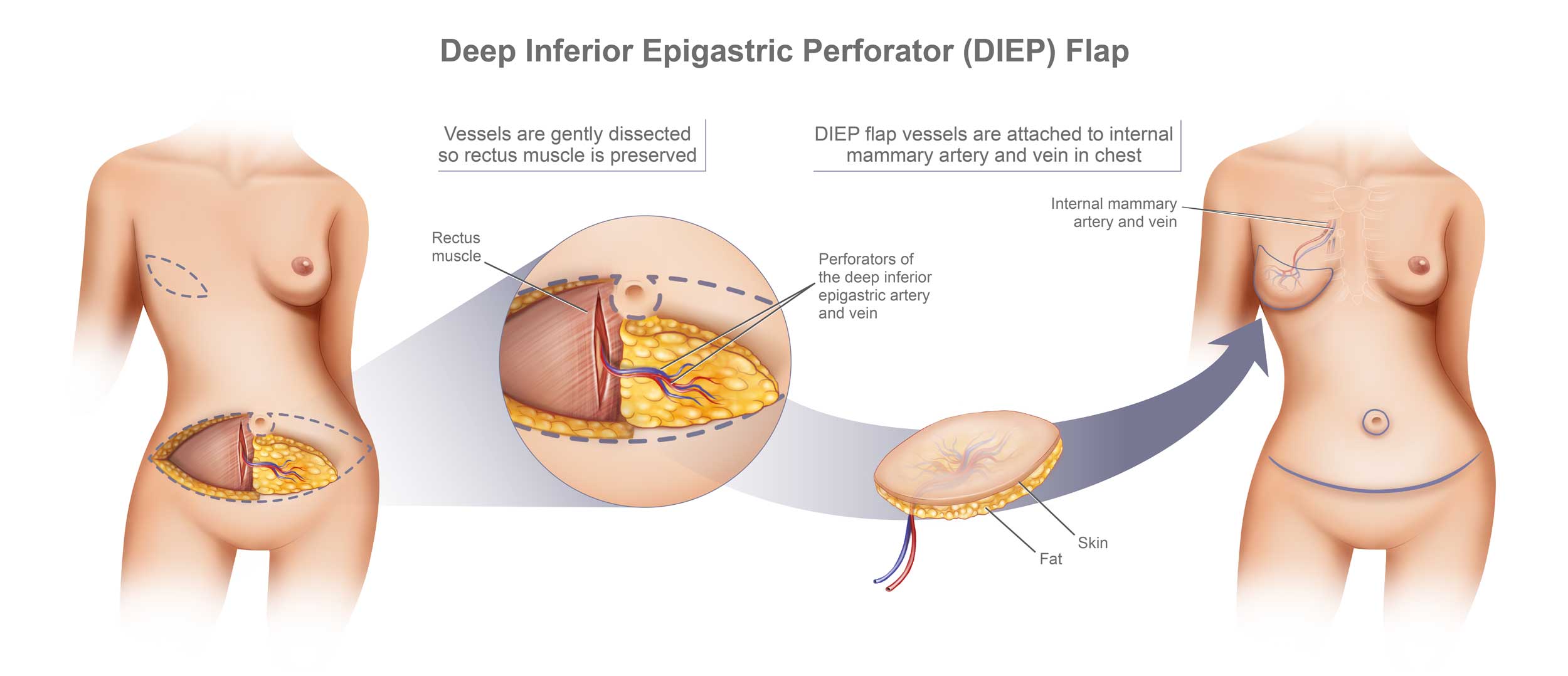
The DIEP flap (Deep Inferior Epigastric Perforator flap) uses skin and fat from the lower abdomen to reconstruct the breast.
As shown in the DIEP flap medical illustration, the surgeon carefully identifies the perforating blood vessels that travel through the abdominal tissue. The surrounding abdominal muscles are preserved, which helps maintain core strength.
During surgery:
- Skin and fat from the lower abdomen are removed along with the perforator blood vessels
- The abdominal muscles are left intact
- The tissue is transplanted to the chest
- Microsurgery is used to reconnect the blood vessels to vessels in the chest
Because the tissue comes from the lower abdomen, many patients notice a result similar to a tummy tuck effect at the donor site.
The abdomen often provides enough tissue for moderate to larger breast reconstruction, which is why the DIEP flap is commonly the first option considered when patients are candidates.
DIEP Flap vs PAP Flap Breast Reconstruction: How the PAP Flap Procedure Works
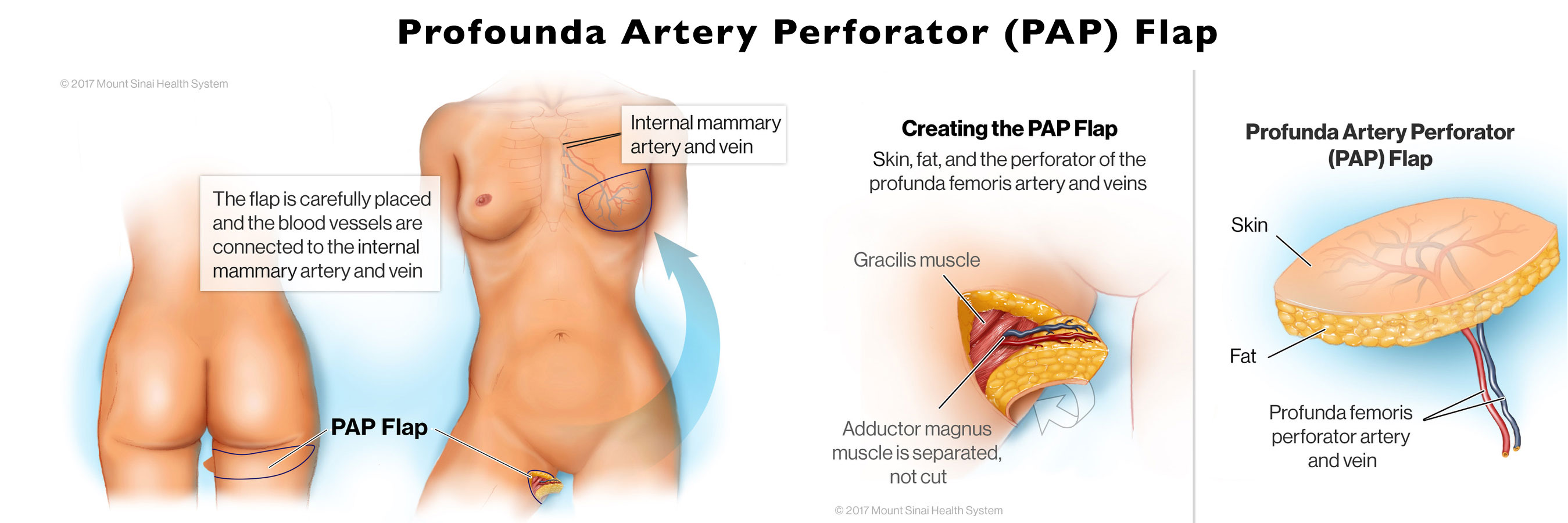
The PAP flap (Profunda Artery Perforator flap) uses skin and fat from the upper inner thigh instead of the abdomen.
The PAP flap medical illustration demonstrates how tissue is taken from the area just beneath the buttock crease along the inner thigh. This allows the scar to sit within the natural fold of the body.
During the PAP flap procedure:
- Skin and fat from the upper inner thigh are removed with their blood vessels
- The thigh muscles are preserved
- The tissue is transferred to the chest
- Microsurgery reconnects the blood vessels to restore circulation
The PAP flap is especially helpful for patients who:
- Do not have enough abdominal tissue for a DIEP flap
- Have had previous abdominal surgery
- Prefer reconstruction that uses tissue from the thigh
Although the amount of tissue available from the thigh is typically smaller than the abdomen, PAP flaps can still create very natural reconstruction results.
DIEP Flap vs PAP Flap Breast Reconstruction: Which Option Is Right for You?
The best procedure depends on a number of factors, including:
- Your body shape and available donor tissue
- Previous surgeries
- Desired breast size
- Overall health and surgical history
Many women are ideal candidates for DIEP flap reconstruction, but the PAP flap provides an excellent alternative when abdominal tissue is not available.
A consultation with an experienced microsurgical breast reconstruction specialist allows for a detailed evaluation of potential donor sites and reconstruction goals.
DIEP Flap vs PAP Flap Breast Reconstruction: Benefits of Natural Tissue Reconstruction
Both DIEP and PAP flap procedures offer important advantages compared with implant-based reconstruction.
These include:
- Reconstruction using your own living tissue
- A breast that looks and feels natural
- No implants to maintain or replace
- Long-term durability
Preservation of important muscles at the donor site
Because the reconstructed breast is made from your own tissue, it can respond more naturally to changes in weight and aging over time.
DIEP Flap vs PAP Flap Breast Reconstruction: Consultation at The Center for Breast Reconstruction
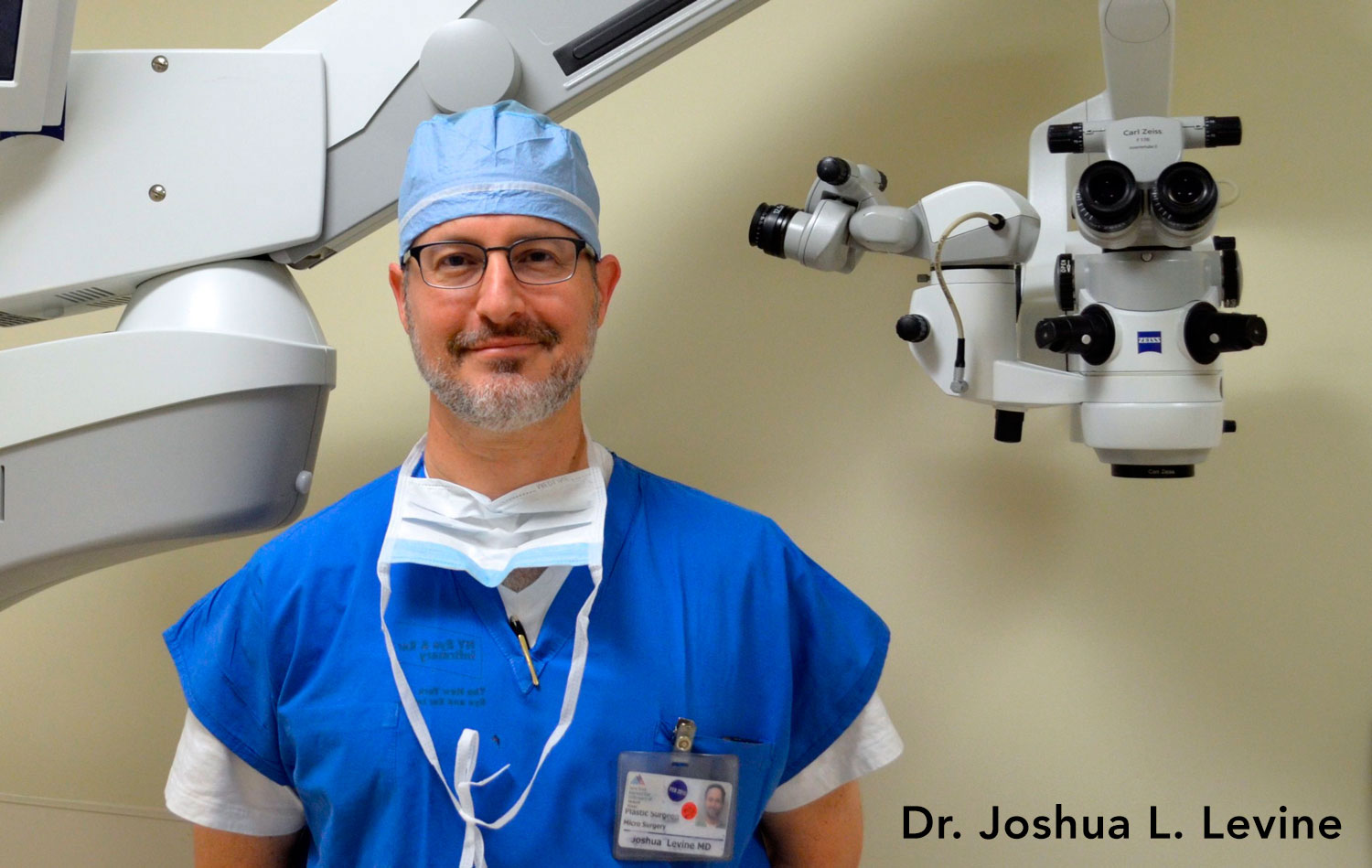
Choosing the right reconstruction technique requires careful planning and surgical expertise. At The Center for Breast Reconstruction, Dr. Levine works closely with each patient to determine the most appropriate approach based on their anatomy and goals.
Detailed medical illustrations of the DIEP flap and PAP flap procedures are also used during consultations to help patients visualize how the reconstruction is performed and where the donor tissue will come from.
For many women, advances in microsurgical reconstruction mean there are now multiple natural tissue options available, even when abdominal tissue is not suitable.
DIEP Flap vs PAP Flap Breast Reconstruction FAQ
What is the difference between a DIEP flap and a PAP flap?
The main difference between a DIEP flap and a PAP flap is the donor site used for the reconstruction. The DIEP flap uses skin and fat from the lower abdomen, while the PAP flap uses tissue from the upper inner thigh. Both procedures preserve muscle and use microsurgery to reconnect blood vessels.
Who is a candidate for PAP flap breast reconstruction?
The PAP flap is often recommended for patients who do not have enough abdominal tissue for a DIEP flap or who have had previous abdominal surgery. It provides a natural tissue reconstruction option using tissue from the upper inner thigh.
Is DIEP flap better than PAP flap?
Neither procedure is universally better. The best option depends on a patient’s anatomy, available donor tissue, and surgical history. During consultation, a microsurgical breast reconstruction specialist evaluates which procedure may provide the best outcome.
Can PAP flap and DIEP flap reconstruction look natural?
Yes. Both DIEP and PAP flap procedures use the patient’s own living tissue, which can create a breast reconstruction that looks and feels natural.
Relevant Links
Dr. Levine’s Advanced Procedures
Dr. Levine, a leading DIEP flap breast reconstruction surgeon, has developed pioneering techniques in extension and stacked flap procedures, making all women candidates regardless of body type.
Patient Results Before & After Gallery
The photographs in this section are of actual patients of Dr. Joshua Levine. They have undergone various types of natural tissue breast reconstruction.
Breast Reconstruction Education Video Library
Our video library offers a comprehensive collection of educational videos on breast reconstruction. It includes detailed procedure narrations with medical illustrations and insightful lectures and talks by Dr. Levine.