Breast reconstruction education

What is Microsurgery?

Microsurgery, one of the most precise and demanding skills in all of surgery, makes natural tissue reconstruction possible, and is why a surgeon’s training in it matters so much.

Microsurgery, in Plain Terms

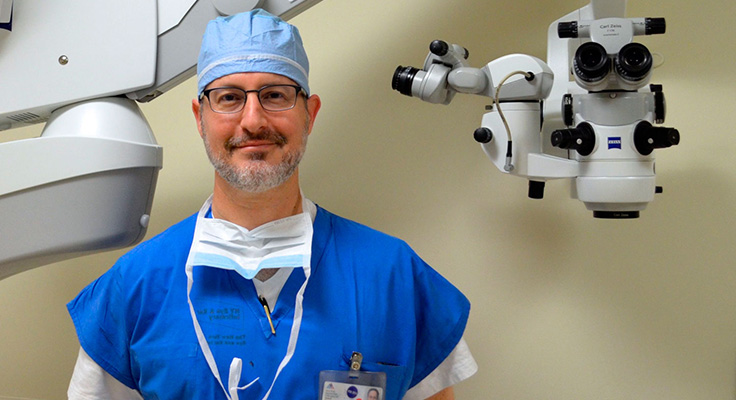
Microsurgery is surgery performed under a high-powered operating microscope. It lets a surgeon repair and reconnect structures too small to work on with the naked eye, such as tiny blood vessels and nerves.

In breast reconstruction, the blood vessels a microsurgeon reconnects are often just one to three millimeters wide. The stitches used to join them are finer than a human hair. Each connection must be perfectly sealed so blood can flow through it without leaking or clotting.

It takes years of dedicated training to perform this work reliably, which is why microsurgery is a subspecialty within plastic surgery rather than a standard part of it.

When reconstruction happens

How microsurgery makes natural tissue reconstruction possible

In natural tissue (autologous) reconstruction, a new breast is created from the patient’s own skin and fat, taken from an area such as the abdomen, thighs, buttocks, or back.

For that tissue to survive in its new location, it needs a blood supply. This is where microsurgery comes in:

remove the flap

The tissue is carefully removed along with the small artery and vein that nourish it. This section of tissue is called a flap.

shape the breast

The flap is moved to the chest and shaped into a breast.

reconnect under the microscope

The surgeon reconnects the flap’s artery and vein to blood vessels in the chest.

restore blood flow

Blood flow is restored, and the tissue lives on as a warm, natural breast that changes with the body over time.

Because the tissue is fully detached and reconnected, this is called a free flap. Without microsurgery, it wouldn’t be possible.

Perforator Flaps: microsurgery at its most refined

Perforator flaps require the highest level of microsurgical skill, because the surgeon has to trace these very small vessels without damaging them. Each is named for the vessel and body area it uses. Common perforator flaps include:

older approach – Tram flap

  • Took abdominal muscle along with skin and fat. This could weaken the abdominal wall and lengthen recovery.

advanced approach – perforator flap

  • The surgeon follows the tiny vessels (perforators) through the muscle and removes only skin and fat — sparing muscle and supporting a better recovery.

Perforator flaps require the highest level of microsurgical skill, because the surgeon has to trace these very small vessels without damaging them. Each is named for the vessel and body area it uses. Common perforator flaps include: DIEP, SIEA, SHaEP, PAP, IGAP, SGAP, TDAP, and ICAP.
Why your surgeon’s microsurgical training matters

Natural tissue reconstruction isn’t offered by every plastic surgeon, because not every plastic surgeon has trained in microsurgery. Outcomes depend heavily on the surgeon’s experience:

Vessel selection

  • Choosing the right vessels affects how well the tissue survives and heals.

Reliable connections

  • Reliable vessel connections protect against complications such as clotting.

options for every body

  • Experience with many flap types means options for women of every body type, including after prior surgery.

When comparing surgeons, ask:

  • Where did you train in microsurgery?

  • How many flap procedures do you perform?

  • Which flap types do you offer?

Your Surgeon

Dr. Levine’s background in microsurgery

Dr. Joshua Levine Breast Reconstruction Surgeon Welcome Text

Dr. Joshua L. Levine has dedicated his practice exclusively to microsurgical perforator flap breast reconstruction since 2004, and has completed more than 1,700 reconstruction procedures.

Trained by the pioneers of the field

  • Plastic surgery residency at Albert Einstein College of Medicine / Montefiore Medical Center under Dr. Berish Strauch, a founding father of microsurgery

  • Board certified by the American Board of Plastic Surgery

  • Microsurgery fellowship at Louisiana State University with Dr. Robert Allen, the pioneer of perforator flap breast reconstruction

Advancing the techniques

  • Pioneered the use of MRI to map the tiny perforator vessels before surgery, helping surgeons choose the best donor tissue and improving outcomes
  • Developed stacked and extended flap techniques, including the SHaEP flap, so women with limited tissue in one area can still have natural reconstruction
  • Co-authored early research describing the deep femoral artery perforator flap, an option that uses thigh tissue

Trained by the pioneers of the field

  • Established the New York Center for the Advancement of Breast Reconstruction at New York Eye & Ear Infirmary of Mount Sinai in 2006, the first center of its kind in New York City, where he serves as Division Chief
  • Co-authored the textbook Perforator Flap for Breast Reconstruction (Thieme, 2016), later translated into Chinese
  • Contributed to more than 30 publications and performed live surgery to teach other surgeons in New York, Barcelona, and Tel Aviv
  • Member of the American Society of Reconstructive Microsurgery, the World Society for Reconstructive Microsurgery, and the Group for the Advancement of Breast Reconstruction

Frequently asked questions

Don’t see your question? Our team is happy to talk it through. Call 212-245-8140

All microsurgeons who perform breast reconstruction are plastic surgeons, but not all plastic surgeons are trained microsurgeons. Microsurgery requires additional fellowship training beyond plastic surgery residency, plus ongoing experience to keep the skill sharp.

Tissue moved to the chest needs its own blood supply to survive. Microsurgery reconnects the tissue’s tiny vessels to vessels in the chest, so it lives on as part of your body.

It uses only your skin and fat, not muscle. The surgeon follows small vessels (perforators) through the muscle and leaves the muscle in place, which helps protect your strength and recovery.

An MRI maps the location and size of your perforator vessels before surgery. This lets the surgeon pick the best tissue and vessels in advance. Dr. Levine helped pioneer this approach.

Most women who want natural tissue reconstruction can be evaluated for it, including women who’ve had radiation, prior surgery or limited abdominal tissue. A consultation and imaging show which donor areas and flap types fit your body.